Septuagesima Sunday (Chapel Masses Cancelled)
***CANCELLATION NOTE: Due to the winter storm, Masses at the Chapel of the Little Flower are cancelled Sunday February 1. Please see note from Father Jones in the Chapel Announcements section below.
For other Latin Mass parish schedule changes please check our special announcement page and verify with the parish website.
Friends in Christ,
Welcome to our weekly Sunday update. The Christmas cycle has now concluded and the liturgy for this Sunday, the first in the pre-Lenten season of Septuagesima, features the parable of the laborers in the vineyard. As we begin to prepare for the season of fasting and penance that will culminate in our remembrance of His passion and death, Jesus tells us that it is never too late to take up our cross and follow Him. Even those who come late will be rewarded in the Kingdom of Heaven.
Septuagesima Sunday is so-named because it falls within the seventy days prior to Easter. Traditionally, it initiates a period of voluntary prayer, penance and solemn reflection leading to the more rigorous weeks of self-denial, penance and good works during Lent. Septuagesima Sunday will be followed during the next two weeks by Sexagesima (“the sixtieth”) and then Quinquagesima (“the fiftieth”), the last Sunday before Lent.
As it is meant to be a period of preparation for the penitential forty days preceding Easter, the liturgy during these weeks takes on added solemnity, omitting the alleluias and the Gloria.
Calendar of Special Observances
Celebrations are those listed in the Roman Missal of 1962.
DAY, DATE – FEAST (CLASS)
Sunday, February 1 – Septuagesima Sunday (II)
Monday, February 2 – The Purification of the Blessed Virgin Mary (II)
Tuesday, February 3 – Feria (IV) – St. Blaise, Bishop and Martyr (IV)
Wednesday, February 4 – St. Andrew Corsini, Bishop and Confessor (III)
Thursday, February 5 – St. Agatha, Virgin and Martyr (III) – Jesus Christ the High Priest (III)
Friday, February 6 – St. Titus, Bishop and Confessor (III) – Sacred Heart of Jesus (III) – Commemoration of St. Dorothy, Virgin and Martyr
Saturday, February 7 – St. Romuald, Abbot (III) – Immaculate Heart of Mary (III)
Septuagesima Sunday
The links provided below can be used to download printable copies of the Proper Prayers for Septuagesima Sunday. A link to Dr. Michael P. Foley’s New Liturgical Movement commentary is also provided.
Traditional Latin Mass Schedule
Diocese of Charlotte Sunday Masses
Chapel of the Little Flower (757 Oakridge Farm Road, Mooresville, NC)
- 10:00 a.m. (Low) - canceled 2/1 due to storm
- 12:00 p.m. (Sung) - canceled 2/1 due to storm
- Winter Storm Cancellations click here.
- Chaplain: Fr. Brandon Jones
- Chapel related questions? Email Father at: tlmchapel(at)rcdoc.org
- More details: https://carolinaliturgy.org/chapel
Note: Only Sunday Latin Masses and Holy Days are offered at the Chapel. This is the only Diocese of Charlotte location which offers the Traditional Latin Mass.
Saint Thérèse of the Child Jesus and the Holy Face, the Little Flower, pray for us!
Diocese of Raleigh Sunday Masses
- 1:00 p.m., Sacred Heart (Dunn, NC)
- 4:30 p.m. - First Sunday, Holy Name Cathedral (Raleigh, NC)
- For additional locations and Masses please see our Mass Times webpage
Diocese of Charleston Sunday Masses
- **3:00 p.m.**, Prince of Peace (Taylors SC) - Due to the storm, Mass is tentatively rescheduled for Sunday February 1 at 3:00 p.m. (Low Mass) in the chapel. However check parish website to reconfirm.
- 1:00 p.m., Our Lady of the Lake (Chapin SC)
- 12:00 p.m., Sacred Heart (Charleston SC)
- 5:30 p.m., Stella Maris (Sullivans Island, SC)
Diocese of Charleston Daily Traditional Latin Masses
- Prince of Peace (Taylors SC) – Monday-Friday, 12:00 p.m.
- Prince of Peace (Taylors SC) – Saturday, 8:00 a.m.
- For additional locations and Masses please see our Mass Times webpage
As a reminder, travelers are urged to consult parish websites or offices for up-to-date information regarding possible changes in the schedule of Mass times.
Upcoming Special Latin Masses
Monday February 2: Feast of the Purification of the Blessed Virgin Mary
- 6:30 p.m. – Our Lady of the Lake (Chapin SC)
- 12:00 p.m. - Prince of Peace (Taylors SC) (with blessing of candles. Mass just announced late on Sunday. Please check parish website before traveling.)
Propers and Commentary for February 2
Wednesday February 18: Ash Wednesday
- 12:00 p.m. – Prince of Peace (Taylors SC) (Includes distribution of ashes)
- 6:30 p.m. – Our Lady of the Lake (Chapin SC) (Includes distribution of ashes)
Chapel of the Little Flower Announcements
***NOTE: Sunday's Masses are Cancelled Due to Storm (February 1)***
Due to the winter storm, Father Jones has cancelled Masses at the Chapel of the Little Flower on Sunday February 1. Please see Father's announcement:
Dear Brothers and Sisters in Christ,
Here we go again! With the impending snowstorm and considering the significant commute the faithful at the Chapel undertake, Masses for Sunday, February 1 are cancelled. Please take care and I shall see you all soon.
In Christ and Our Lady,
Father Jones
Online Viewing of Mass
CTLS note: If you'd like to hear a homily from a Latin Mass for Sunday February 1, one can view the Mass from the Institute of Christ the King Shrine in Cleveland, Ohio at this link.
Mass Intentions for Sunday
Sunday February 1 - + James Honeycutt
Mass intentions for the Chapel of the Little Flower Reopen February 15
The Mass book for the Chapel of the Little Flower will be open again on Sunday, February 15 at 11:30 to allow attendees of both Masses the opportunity to request Mass intentions. If you have already had a Mass offered, please allow others the opportunity to request a Mass. The minimum stipend is $15 and checks must be made out to "Diocese of Charlotte" with "Chapel Mass Stipend" in the memo line or cash will also be accepted. Please be prepared to choose which Mass you are requesting.
Lost and Found
The Chapel has a growing collection of items left behind after Mass. If one is missing a missal, book, or other item, please see the new table in the cry room.
Father Jones’ Contact Info
If one has questions about the Chapel of the Little Flower, that are not related to one’s parish, please email Father Jones directly at: tlmchapel(at)rcdoc.org
Parish Bulletins Now Available at the Chapel
To help Chapel attendees/visitors stay connected with their parishes, the Chapel is providing Sunday bulletins from Saint Ann and Saint Thomas Aquinas parishes.
General Announcements
Traditional Carmelite Lenten Enrollment – Lent is approaching and the Discalced Hermits of Our Lady of Mount Carmel invite the faithful to enroll their family and friends in this annual Lenten Enrollment. The Hermits will be offering the following for the benefit of those enrolled:
- 40 Traditional Latin Masses celebrated according to the Carmelite Rite;
- 40 days of prayer according to the Divine Office, as well as other daily prayers; and
- 40 days of fasting and penance.
Intentions can be for the living or deceased. There is no charge for enrollment, but the Discalced Hermits survive entirely on alms received from the laity to support their apostolate. Please remember the Hermits in your almsgiving during the Season of Lent.
The deadline to enroll is Tuesday February 17, the day before Ash Wednesday. To enroll in the Lenten Enrollment, click here.
Book Announcement: Meditations on the Litany of Humility – Local publisher Sensus Fidelium Press has released an enriching new book on the Litany of Humility according to the writings of the saints. Meditations on the Litany of Humility: From the Examples of the Saints unpacks this important litany through the examples and words of the saints themselves who practiced this foundational virtue. Sensus Fidelium Press and Sensus Fidelium, are run by local parishioner, Steve Cunningham. To order your copy, click here.
Has Sensus Fidelium Helped Grow Your Faith? – Sensus Fidelium, the online traditional Catholic apostolate run by local parishioner Steve Cunningham has helped many grow in their faith through its rich Catholic content (we link to it each week). If it has helped you grow in your faith, might you consider supporting their fundraising campaign with a tax-deductible gift to help them expand their reach and share the perennial Church teachings to more souls? Click here to support them.
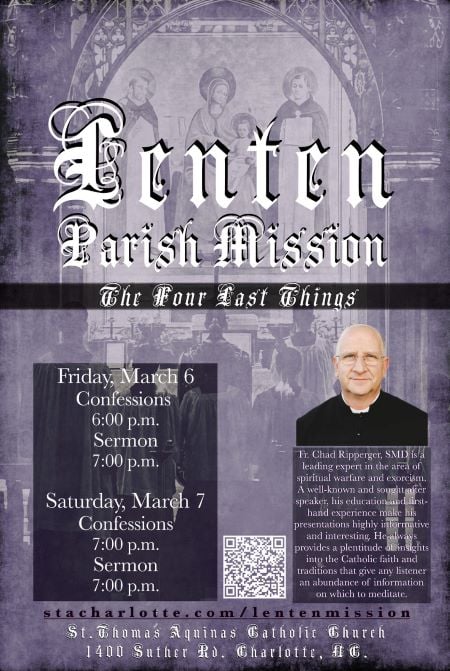
Fr. Ripperger to Offer Lenten Mission at Saint Thomas Aquinas (March 6-7) – Saint Thomas Aquinas parish is blessed to welcome back Fr. Chad Ripperger, SMD, a priest and exorcist with the Society of the Most Sorrowful Mother (the Doloran Fathers), to offer a Lenten Parish Mission in March. Father will offer the mission on Friday March 6 at 7:00 p.m. and Saturday March 7 at 7:00 p.m. Please note: As noted last year, the conference is geared toward adults, and would not be appropriate for younger children. Registration is required. To register click here.
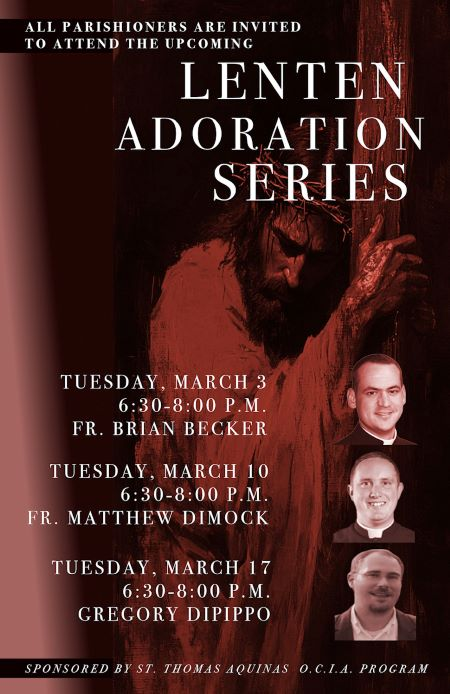
Lenten Adoration Series (Saint Thomas Aquinas) – The parish will hold a Lenten Adoration series on the first three Tuesday evenings in March. Each evening will feature a reflection followed by Adoration of the Blessed Sacrament. This is a stellar lineup of speakers:
- Tuesday March 3, 6:30-8:00 p.m. (Fr. Brian Becker, St. Joseph Seminary)
- Tuesday March 10, 6:30-8:00 p.m. (Fr. Matthew Dimock, Sacred Heart parish)
- Tuesday March 17, 6:30-8:00 p.m. (Greg DiPippo - Editor, New Liturgical Movement)
Please see the flyer at the end of this update.
Support Saint Ann and Saint Thomas Parishes – Although the Latin Mass is offered at the Chapel, our parishes remain the anchor of our spiritual and community lives. Both Saint Ann and Saint Thomas Aquinas parishes (among others) continue to promote the sacred traditions, devotions, speakers and catechesis important for the spiritual growth of ourselves and our families. They also need our continued financial support (and occasional visits!). Both parishes would appreciate our continued generosity - especially as we approach Lent.
The FSSP 30-Day Novena to Our Lady thru February 11th – A thirty-day novena is underway in preparation for the renewal of the Priestly Fraternity of Saint Peter’s (FSSP) consecration to the Immaculate Heart of Mary in February. The novena consists of a daily Rosary and Memorare and concludes February 11 (Our Lady of Lourdes). Saint Ann parish has two parishioners at the FSSP’s seminary in Nebraska. Please consider praying this novena. To learn more click here.
Rosary for the Traditional Latin Mass – A Rosary is offered for the restoration of the Traditional Latin Mass in the church on Sundays after the 11:30 a.m. Novus Ordo Mass at Saint Thomas Aquinas Church.
Daily Holy Face Chaplet for Sacred Liturgy (perpetual novena) – For the preservation of the Traditional Latin Mass, it has been recommended to all friends of the sacred liturgy in the diocese to consider continually praying the powerful Holy Face chaplet, under the banner of Our Lady of the Holy Name. To pray the chaplet, please see this link.
Cardinal Burke’s Prayer for Pope Leo XIV – His Eminence Cardinal Raymond Burke has released a prayer for Pope Leo XIV. Please see the prayer at the links below and consider praying this daily for the Holy Father as he leads the Church. PDF copies can be accessed at these links: [English] [Español] [Latin]
Holy Face Devotions
Prayers of Reparation to the Holy Face of Jesus are offered each week at the following churches on the indicated days:
- St. James (Concord) – Monday, 10-10:30 a.m. (in the cry room)
- St. Mark – Tuesday, 5:30 p.m.
- St. Thomas Aquinas – Tuesday, 6:00 a.m.
- St. Ann – Tuesday, 7:30 a.m. (following 7:00 a.m. Mass)
- St. Michael the Archangel (Gastonia) – Tuesday, 8:30 a.m. (following 8:00 a.m. Mass)
- St. Vincent de Paul – Tuesday, 8:40 a.m.
- Holy Spirit (Denver) – Tuesday, 10-11:00 a.m. (following the 9:15 a.m. Mass)
- Saint Elizabeth of the Hill Country (Boone) – Third Tuesday, at 6:45 p.m. after Mass in the Youth Room
- St. John the Baptist (Tryon) - First Saturday, 9:30 a.m. (after 8:30 a.m Mass)
Note: Days and times may be subject to change due to holidays.
“Jesus, Your ineffable image is the star which guides my steps. Ah, You know, Your sweet Face is for me Heaven on earth” (from Canticle to the Holy Face by Saint Thérèse de Lisieux, the 19th century Discalced Carmelite nun who took the name in religion, Thérèse of the Child Jesus and the Holy Face).
Traditional Latin Mass and Liturgical News
- Septuagesima: The Time that the Land Forgot by Dr. Michael P. Foley, The New Liturgical Movement (February 3, 2021). [Septuagesima]
- The Purification of Mary by Saint Alphonsus Liguori, Voice of the Family (January 29, 2025). [The Purification of Mary]
- Ave Regina Caelorum by Greg DiPippo, New Liturgical Movement (February 3, 2025). [Ave Regina Caelorum]
- Dom Guéranger on the Procession with Candles at Candlemas, Clear Creek Abbey (January 21, 2026). [Procession of Candles at Candlemas]
- A Monastic Revival in America? Two Monks Discuss Renewal in a Post-Christian Age (Video) by St. Michael and Our Lady of Clear Creek Abbeys (January 22, 2026). [A Monastic Revival in America]
- New The Second Feast of Saint Agnes: A Liturgical Oddity by Greg DiPippo, New Liturgical Movement (January 28, 2025). [The Second Feast of Saint Agnes]
- New Church Architecture: St. Catherine of Siena Catholic Church in Wake Forest, North Carolina by Shawn Tribe, Liturgical Arts Journal (January 22, 2026). [Saint Catherine of Sienna Church]
- Audience with Pope Leo XIV, Communiqué of the Priestly Fraternity of St. Peter (FSSP), January 20, 2026. [Audience with Pope Leo XIV]
- The Ancient Ambrosian Rite in Milan by John Paul Sonnen, Liturgical Arts Journal (January 14, 2026). [Ancient Ambrosian Rite in Milan]
Saints and Special Observances
Saint Ignatius of Antioch, Bishop and Martyr, was one of the three first-century bishops who are together called the Apostolic Fathers of the Church because they actually knew the Apostles and passed on what they had been taught by the first followers of Our Lord. The others were Saint Clement of Rome and Saint Polycarp, Bishop of Smyrna. Saint Clement, a follower of Saint Peter who became the fourth Bishop of Rome, suffered martyrdom in 99 A.D. Saint Polycarp, who was Bishop of Smyrna, ended his life as a martyr at the age of 86. Saint Ignatius was the third Bishop of Antioch, occupying a see that had first been held, like that of Rome, by Saint Peter. He and Polycarp were close friends and associates, and both were followers of Saint John the Evangelist.
Ignatius was born around the year 50 A.D. and was Bishop of Antioch during the persecution of Christians under the Emperor Domitian. Having successfully guided his flock through that storm, he faced another when Trajan came to power in Rome. The Martyrdom of Ignatius, composed by two associates of the bishop who accompanied him on his final journey to Rome, begins by praising his performance in the face of this renewed threat to the Christian community: When Trajan, not long since, succeeded to the empire of the Romans, Ignatius, the disciple of John the apostle, a man in all respects of an apostolic character, governed the Church of the Antiochians with great care, having with difficulty escaped the former storms of the many persecutions under Domitian, inasmuch as, like a good pilot, by the helm of prayer and fasting, by the earnestness of his teaching, and by his spiritual labour, he resisted the flood that rolled against him, fearing lest he should lose any of those who were deficient in courage, or apt to suffer from their simplicity.
A temporary relaxation of the persecution brought peace to the community for a time but left Ignatius longing for that consummation of his own life that would be the ultimate realization of his love for Christ. “For he inwardly reflected, that the confession which is made by martyrdom, would bring him into a yet more intimate relation to the Lord.”
In the ninth year of his reign, Trajan demanded that all of his subjects worship the pagan gods of Rome. Ignatius imparted to the Christians of Antioch the courage to remain true to their faith. Called before the emperor, when that ruler was at Antioch, Ignatius spoke eloquently in defense of his flock and his faith. Trajan responded by ordering that the bishop be sent to Rome in chains to be fed to wild beasts for the entertainment of the people.
Ignatius was accompanied on his journey to Rome by Philo, a deacon from Tarsus, and a Syrian named Rheus Agathopus. In The Martyrdom of Ignatius, they wrote of the great hardships endured by the bishop as he traveled to his place of execution. Writing himself to the Christians at Rome, while enroute to that city, Ignatius said, "From Syria even to Rome I fight with wild beasts, by land and sea, by night and by day, being bound amidst ten leopards, even a company of soldiers, who only grow worse when they are kindly treated."
Ignatius and his captors traveled overland from Antioch to Seleucia before setting sail from that city for Rome. “And after a great deal of suffering he came to Smyrna, where he disembarked with great joy, and hastened to see the holy Polycarp, his fellow disciple and bishop of Smyrna. For they had both, in old times, been disciples of St. John the Apostle.” Throughout the journey he was greeted with effusive expressions of love and concern by the members of local churches. Along the way he composed six letters addressed to the Christians of Ephesus, Magnesia, Tralles, Rome, Philadelphia and Smyrna, and a seventh sent to Polycarp. Saint John Henry Newman summed up the importance of these letters when he said that "the whole system of Catholic doctrine may be discovered, at least in outline, not to say in parts filled up, in the course of his seven epistles."
Upon his arrival in Rome, Ignatius knelt with his fellow Christians there and “entreated the Son of God on behalf of the Churches, that a stop might be put to the persecution, and that mutual love might continue among the brethren” before being “led with all haste into the amphitheatre” to be cast to the wild beasts ready to consume him.
The Church dates his martyrdom in the year 110 A.D. and celebrates his feast on the 1st of February each year. [Source: Catholic Encyclopedia, New Advent.org]
Closing Commentary
In closing, we share two commentaries extracted from The Liturgical Year of Dom Prosper Guéranger for “Septuagesima Sunday.”, “The History of Septuagesima” followed by a reflection of the Feast of the Purification which is commemorated this Monday February 2. A link to the full text of the great liturgist’s commentary follows the extract.
The History of Septuagesima
The Season of Septuagesima comprises the three weeks immediately preceding Lent. It forms one of the principal divisions of the Liturgical Year, and is itself divided into three parts, each part corresponding to a week: the first is called Septuagesima; the second, Sexagesima; the third, Quinquagesima.
All three are named from their numerical reference to Lent, which, in the language of the Church, is called Quadragesima, — that is, Forty, — because the great Feast of Easter is prepared for by the holy exercises of Forty Days. The words Quinquagesima, Sexagesima, and Septuagesima, tell us of the same great Solemnity as looming in the distance, and as being the great object towards which the Church would have us now begin to turn all our thoughts, and desires, and devotion.
Now, the Feast of Easter must be prepared for by a forty-days’ recollectedness and penance. Those forty-days are one of the principal Seasons of the Liturgical Year, and one of the most powerful means employed by the Church for exciting in the hearts of her children the spirit of their Christian Vocation. It is of the utmost importance, that such a Season of grace should produce its work in our souls, — the renovation of the whole spiritual life.
The Church, therefore, has instituted a preparation for the holy time of Lent. She gives us the three weeks of Septuagesima, during which she withdraws us, as much as may be, from the noisy distractions of the world, in order that our hearts may be the more readily impressed by the solemn warning she is to give us, at the commencement of Lent, by marking our foreheads with ashes. [History of Septuagesima]
Purification of the Blessed Virgin Mary
The Forty Days of Mary’s Purification are now completed, and she must go up to the Temple, there to offer to God her Child Jesus. Before following the Son and his Mother in this their mysterious journey, let us spend our last few moments at Bethlehem, in lovingly pondering over the mysteries at which we are going to assist.
The Law commanded, that a woman, who had given birth to a son, should not approach the Tabernacle for the term of forty days; after which time, she was to offer a sacrifice for her Purification. She was to offer up a lamb as a holocaust, and a turtle or dove as a sin-offering. But if she were poor, and could not provide a lamb, she was to offer, in its stead, a second turtle or dove.
By another ordinance of the Law, every first-born son was to be considered as belonging to God, and was to be to redeemed by six sides, each side weighing, according to the standard of the Temple, twenty *obols. (*Leviticus 12; Exodus 30:13. The Obol was about three half-pence of English money)
Mary was a Daughter of Israel — she had given Birth to Jesus — he was her First-born Son. Could such a Mother, and such a Son, be included in the Laws we have just quoted? Was it becoming that Mary should observe them? [Purification of the Blessed Virgin Mary]